EU Referendum Voting Guide: Vote Leave on international influence

What was claimed
We will retake our seats on international bodies. […] We will have more international influence and use it to encourage more friendly international cooperation.
Our verdict
The UK already sits on many international bodies individually, as do representatives of the EU as a whole.
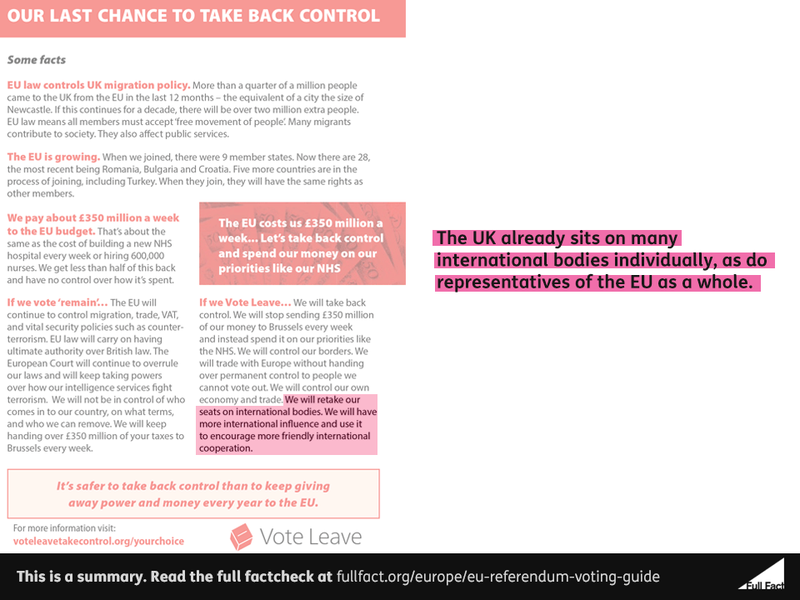
The picture of the UK and EU’s international roles is much more mixed than either Stronger In or Vote Leave suggest in these leaflets.
A recent report by Parliament’s Foreign Affairs Committee mentions NATO, the UN Security Council, the Commonwealth, the G8 group, the G20 group, the OECD, the Council of Europe and the World Trade Organisation as examples of key international bodies.
Join 74,000 newsletter subscribers who trust us to check the facts
Sign up to get weekly updates on politics, immigration, health and more.
Subscribe to weekly email newsletters from Full Fact for updates on politics, immigration, health and more. Our fact checks are free to read but not to produce, so you will also get occasional emails about fundraising and other ways you can help. You can unsubscribe at any time. For more information about how we use your data see our Privacy Policy.
The UK is an individual member of all these organisations. But the EU is also represented, in one way or another, at many of them.
Its role varies. At the World Trade Organisation, the European Commission “speaks for all EU member States at almost all WTO meetings”, meaning the UK doesn’t represent itself independently.
The EU “participates as an equal” at the G8, according to the American Council on Foreign Relations think tank. That’s not the case at the OECD, where it doesn’t have voting rights, but the OECD says that “the European Commission’s participation goes well beyond that of an observer”.
Was this helpful?
Full Fact fights for good, reliable information in the media, online, and in politics.