The Telegraph’s poll figures on suspending parliament are misleading

What was claimed
Boris Johnson has the support of more than half of the public to deliver Brexit by any means, including suspending Parliament, according to a poll.
Our verdict
Incorrect. The poll showed that 44%, not a majority, agreed with the statement. There are also other problems with the poll.
Since we originally wrote this the Telegraph has corrected their article.
“Boris Johnson has the support of more than half of the public to deliver Brexit by any means, including suspending Parliament, according to a poll.”
The Telegraph, 13 August 2019
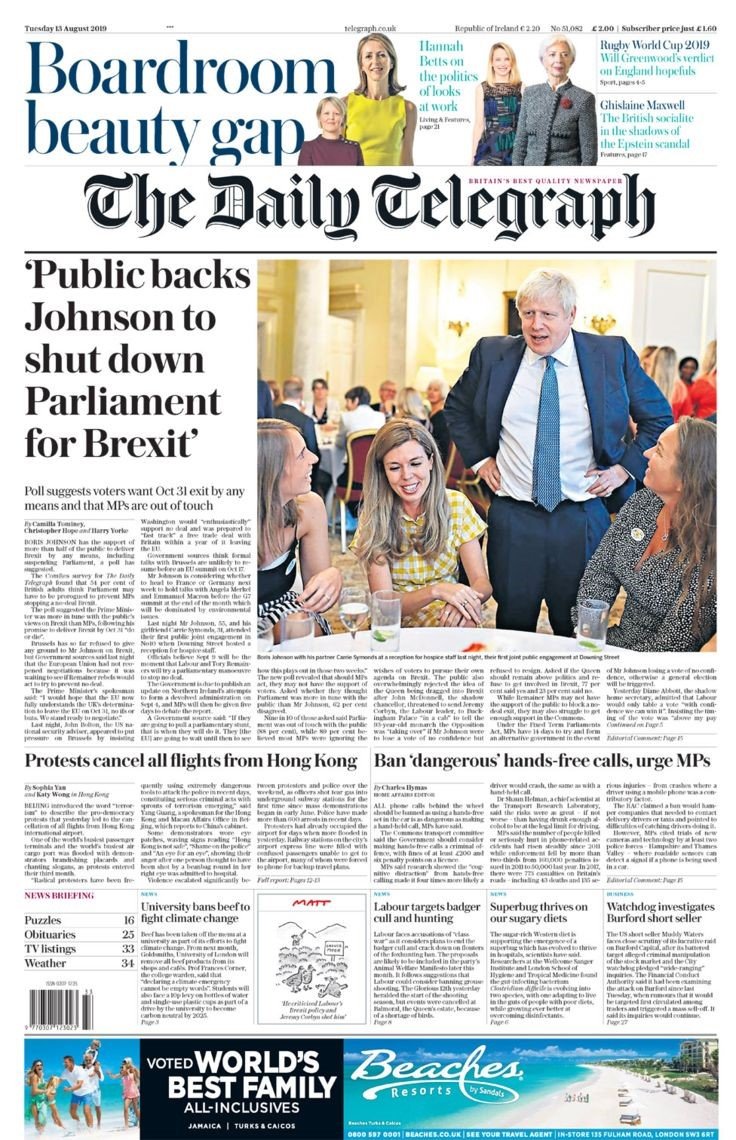
The Telegraph recently commissioned pollster ComRes to survey a representative sample of adults in Great Britain on Brexit.
The Telegraph presented the results in their front-page splash, claiming that more than half the public support Boris Johnson delivering Brexit by any means possible, including suspending Parliament. This was repeated by various media organisations including Metro and Reuters.
Join 74,000 newsletter subscribers who trust us to check the facts
Sign up to get weekly updates on politics, immigration, health and more.
Subscribe to weekly email newsletters from Full Fact for updates on politics, immigration, health and more. Our fact checks are free to read but not to produce, so you will also get occasional emails about fundraising and other ways you can help. You can unsubscribe at any time. For more information about how we use your data see our Privacy Policy.
This claim is incorrect.
The exact question was:
“Do you agree or disagree with the following statements?
“Boris needs to deliver Brexit by any means, including suspending parliament if necessary, in order to prevent MPs from stopping it.”
44% agreed, 37% disagreed and 19% said they didn’t know.
44% does not, as the Telegraph claims, represent more than half of the public.
The Telegraph excluded all the people who said they didn’t know from its reported findings in order to claim that a majority of the public (54%) agreed. This isn’t appropriate.
The Telegraph could have said that more people agreed with the statement than didn’t. Or that the majority of people with a view on the matter agreed. But not that the majority of the public agreed.
Since we originally wrote this, we got in touch with the Telegraph, who have now corrected their article.
As well as the problems with the Telegraph’s interpretation of the results, there are also problems with the question itself. The question has been phrased in such a way that it could lead people to agree with it.
For example, implicit in the statement is the idea that parliament will definitely stop Brexit. Not delay, but stop Brexit. This essentially inflates the perceived risk to Brexit of not proroguing parliament. Which might lead more people to agree with the statement.
There’s also arguably a broader problem with this sort of agree/disagree question as explained here by YouGov’s Director of Political Research, Anthony Wells.
He argues that the statements people have to agree or disagree with can only advocate for one side of the debate and so can lead respondents to agree by default.
In this example, the “benefit” of the Prime Minister taking any means possible, including suspending parliament, to deliver Brexit is clear. Brexit would be delivered.
But the other side of this debate is not spelled out or suggested, for example what might happen if Mr Johnson did not suspend parliament. So the wording used might have made it more likely for people to say they agree with the statement.
And finally, as we say often, this poll is only representative of people in Great Britain (it excludes Northern Ireland, which voted to Remain) as the Telegraph does mention in its article.
We took a stand for good information.
We got in touch to request corrections regarding claims made in The Sun and in The Telegraph.
The Sun deleted the article.
The Telegraph made a correction.
Update 29 August 2019
After we approached the Telegraph, it amended the top two lines of the article to make it clear that the figures represent only those who had a view on the matter. The newspaper also added a clarification to the article saying this figure excluded ‘don't know’ and refusal responses.
Was this helpful?
Full Fact fights for good, reliable information in the media, online, and in politics.