What is the NHS paying for Private Finance Initiatives?

What was claimed
£1 in every £10 that goes to the NHS is to pay off debts from Private Finance Initiatives (PFIs).
Our verdict
This isn’t correct according to the latest cost estimates. These suggest ongoing annual costs are about 2% of the NHS budget, or £1 in every £55.
“Another part of the problem that we've got is that Labour decided to sign us up to these crazy PFI deals so for every pound out of every ten that goes into the NHS is going to pay off the debt that you guys saddled us with.”
Paul Nuttall MEP, 30 March 2017
This isn’t correct according to the latest cost estimates for Private Finance Initiatives (PFIs) to the NHS in England. These suggest ongoing PFI payments cost the equivalent of around 2% of the NHS budget, or one pound in every £55.
We don’t yet know where Mr Nuttall’s figures come from, and we’re trying to get in touch.
Join 74,000 newsletter subscribers who trust us to check the facts
Sign up to get weekly updates on politics, immigration, health and more.
Subscribe to weekly email newsletters from Full Fact for updates on politics, immigration, health and more. Our fact checks are free to read but not to produce, so you will also get occasional emails about fundraising and other ways you can help. You can unsubscribe at any time. For more information about how we use your data see our Privacy Policy.
What are PFIs?
PFIs are a kind of procurement where the private sector manages the delivery of public sector projects. This typically involves designing, building, financing and operating a government facility or service, like a hospital. The private sector owns the assets and leases them to the government.
It’s different from most public sector projects where the government owns the assets and does most of these things itself, although private contractors are often still used to deliver some services and the end of the process.
PFIs are paid for upfront by groups of private investors, who take on the risks of construction. The government pays later, in the form of annual payments called “unitary charges”. These cover the costs of the services being delivered, plus the costs of interest and repayment of the debt.
PFIs have provoked a lot of controversy since their introduction in the early 1990s. The House of Commons Library has outlined some of the general arguments for and against them.
£2 billion annual cost of PFIs to the NHS
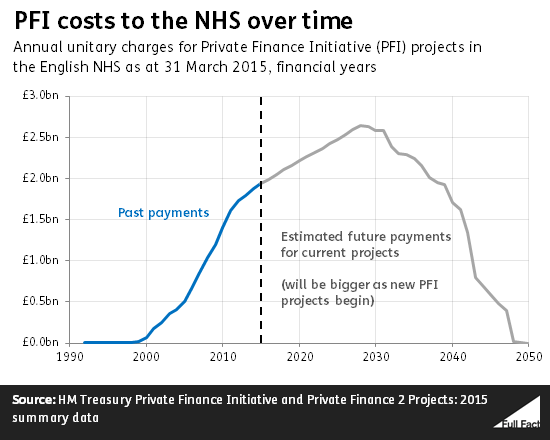
In 2016/17 the NHS in England paid an estimated £2 billion for past and current PFI projects. That’s about 2% of the NHS England budget of about £108 billion and a similar proportion of total Department of Health spending, of about £120 billion.
The latest figures, as of 2015, show the department is currently paying for 105 NHS projects and will be paying for them until 2050, although the costs will fall towards this date as the payments for earlier projects end.
Similarly, total PFI repayments this year are expected to be about £10.4 billion, but that includes PFIs in other government departments. The Department of Health is the biggest user in terms of costs, but the Departments for Education and Transport and the Ministry of Defence are all big users of PFIs as well.
Was this helpful?
Full Fact fights for good, reliable information in the media, online, and in politics.